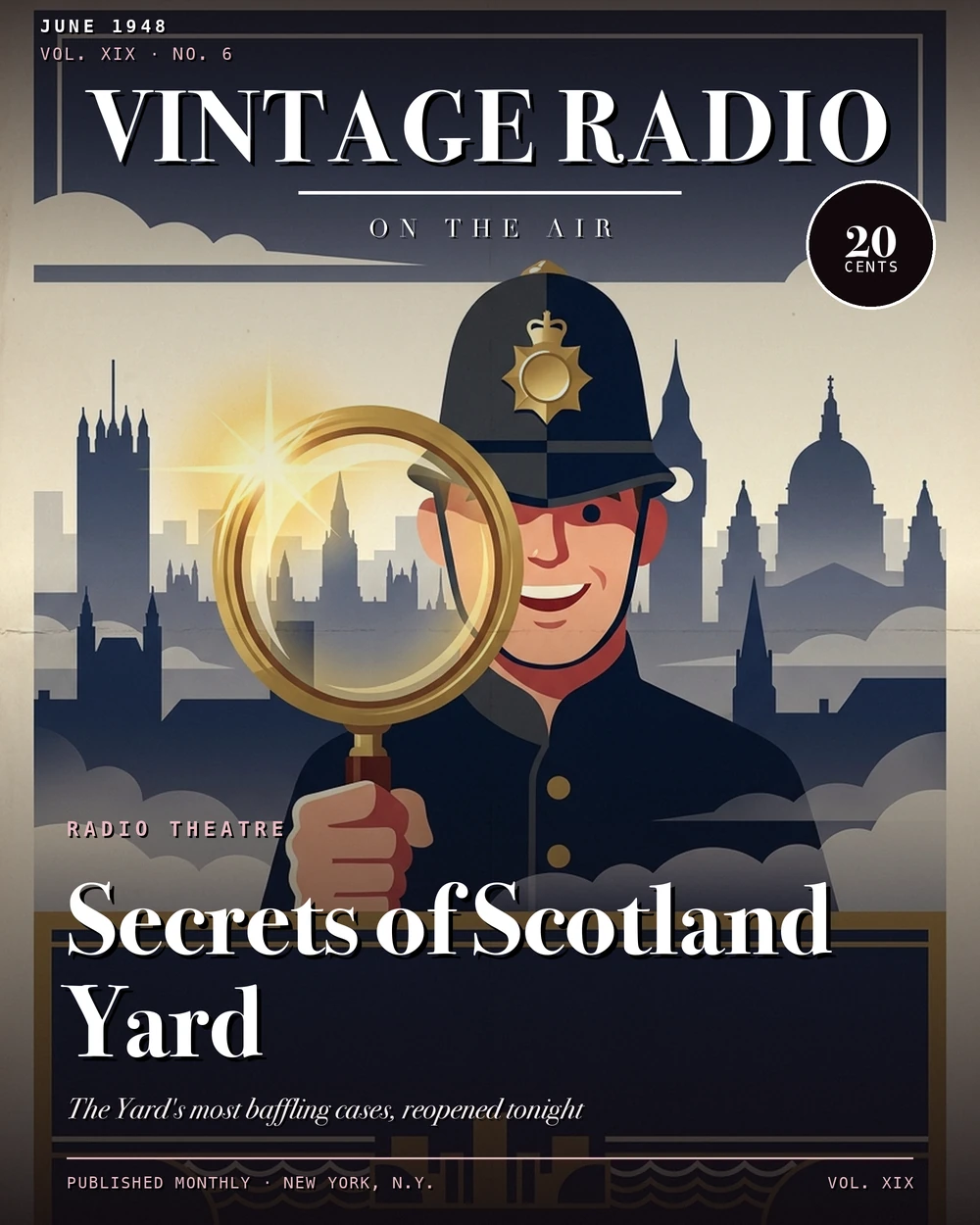
Secrets of Scotland Yard
The Idea Behind It
What set Secrets of Scotland Yard apart from the crowded field of radio crime dramas was its insistence on the real. Rather than building fictional detectives and invented crimes, the series went back to the actual case files of Scotland Yard — the theft of the British Crown Jewels by Colonel Thomas Blood, infamous Victorian and Edwardian-era murders, crimes that had genuinely rattled the public — and dramatized them as reconstructions. The effect was something between a documentary and a thriller: the plot was real, the stakes had already been settled by history, and yet the storytelling kept the tension alive.
The series ran from 1949 to roughly 1951 in international syndication, then surfaced again on the American Mutual Broadcasting System in 1957, with that run extending to 1959. Fifty-seven episodes are catalogued, though the full production ran to well over a hundred — a substantial body of work for a half-hour crime drama that was never anchored to a single national network in the conventional sense.
Harry Alan Towers and the Towers of London Machine
The driving force behind the series was producer Harry Alan Towers, who had co-founded Towers of London with his mother, Margaret Miller Towers, in 1946. Their business model was syndication — producing radio programmes and distributing them internationally — at a time when most radio drama was tied to a single sponsor or network. Secrets of Scotland Yard was one of the company's flagship titles, designed from the start for worldwide distribution rather than for a domestic American or British audience alone.
Towers was a prolific operator. Under the Towers of London label he produced at least three other Scotland Yard–related radio series: The Black Museum, hosted by Orson Welles; Fabian of the Yard; and WHItehall 1212. There was deliberate overlap between these productions. Both Secrets of Scotland Yard and The Black Museum dramatized the same actual case files — but with entirely different scripts and entirely different casts. When Towers approached Welles about The Black Museum in 1951, following the completion of The Adventures of Harry Lime, it was essentially a reworking of the Secrets of Scotland Yard material in a new package. One episode of the original series, "The Bone From A Voice Box," is noted as the direct prototype for The Black Museum. Towers ran his productions like a repertory of material as much as a collection of individual shows.
Clive Brook and the Voice of Authority
The first host and narrator of the series was Clive Brook, born Clifford Clive Hardman Brook on 1 June 1887 in London. He was already a prominent British film actor by the time the series launched — known to cinema audiences for playing Sherlock Holmes in the 1932 film of the same name, and for appearing opposite Marlene Dietrich in Shanghai Express that same year. He had also played a retired naval commander in the 1936 film Scotland Yard Commands, which gave him a specific association with the subject matter that Towers clearly found useful.
Brook hosted the series for approximately its first year before being replaced by an actor playing a character identified simply as "Superintendent X" of Scotland Yard. The shift from a named, real-world personality to an anonymous institutional figure was in keeping with the show's documentary ambitions — the Yard itself was the protagonist, not any individual.
During his time on the series, Brook occasionally brought in Percy Hoskins, a crime reporter for the London Daily Express who had personally covered many of the major criminal cases of the day. Hoskins was also one of the founders of the Saints and Sinners Club of London, an organisation focused on true crime investigation methods. His presence gave the dramatizations a further layer of credibility — here was someone who had actually stood at crime scenes and reported on trials, talking through cases on air as though in conversation with Brook.
How the Episodes Were Built
The show's structure was straightforward but effective. Each half-hour episode presented a single case, narrated and dramatized in a way that blended the procedural and the theatrical. The detectives at the center of these stories were defined by deductive reasoning, intuition, and the kind of collaborative casework that real Scotland Yard investigations actually required — not the lone eccentric genius of the classic British mystery tradition, but professionals working through evidence together.
Cases covered a wide range: theft, murder, espionage, fraud. Episode titles from the surviving catalog give a sense of the territory — Liverpool Bank Fraud, Murder at Moat House Farm, Kindly Doctor, Murder Without Motive, Lucky Murderer, Murder Most Foul. Some reached back to the Victorian and Edwardian eras; others sat closer to the present day. The series was deliberately presented as educational as well as entertaining, with the framing suggesting that the audience was getting an inside look at how Scotland Yard actually operated.
The US Run and What Survives
The international syndication model meant the series reached audiences in multiple countries before it ever landed on American airwaves. When it did come to the Mutual Broadcasting System in 1957, it was a late arrival — radio drama in the United States was already deep into its decline in the face of television. The Mutual run continued to 1959, making Secrets of Scotland Yard one of the last new dramatic series to find an American home in the medium's twilight years.
The complete set for the series was certified on 17 December 2006 (Version 3, one disc), covering 57 episodes. The full production run was considerably larger, but like many syndicated programs of the era, not every episode has come down to the present in equal measure. What survives is a representative cross-section of the series' approach — case reconstructions, London settings, and the particular combination of documentary credibility and radio drama craft that Towers and his team built into the format from the beginning.